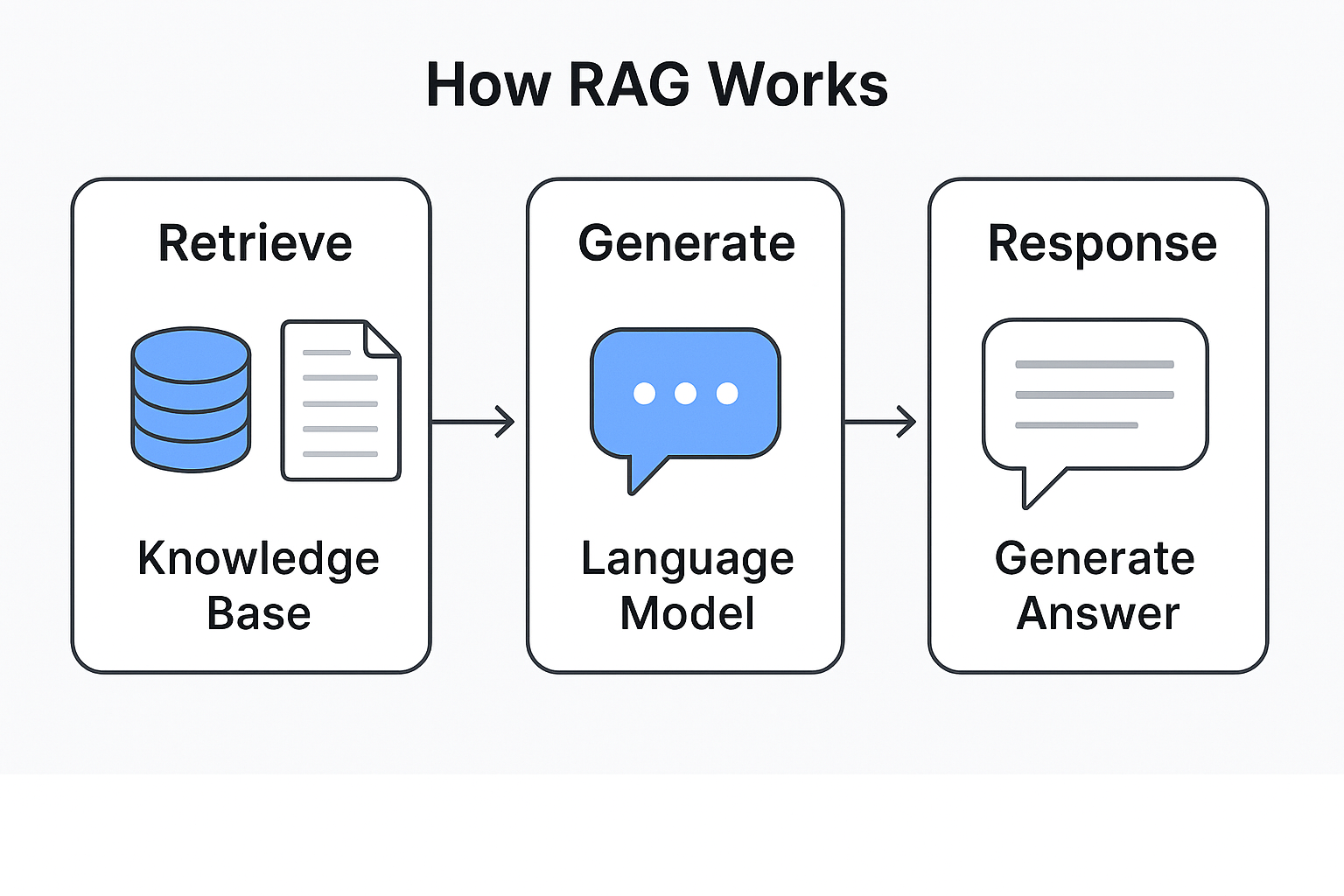
Imagine you’re writing an essay. You know some things, but you also look up facts from books or Google to make your essay accurate. That’s exactly what RAG does for AI.
- Retrieval: The AI searches for relevant information from a knowledge source (like a database or documents).
- Generation: It then uses that information to create a well-formed answer.
Instead of relying only on what it was trained on, RAG combines stored knowledge with real-time data. This makes responses more accurate, relevant, and trustworthy.
Why is RAG Important for GenAI?
Generative AI models like ChatGPT or Bard are trained on massive datasets, but they can’t know everything—especially recent events or niche topics. Without RAG, they might:
- Give outdated answers
- “Hallucinate” facts (make things up)
RAG solves this by pulling fresh, verified information before generating a response. This is why many enterprise AI systems use RAG for tasks like:
- Customer support
- Legal document analysis
- Healthcare knowledge retrieval
How Does RAG Work? (Simple Version)
- Ask a Question: You type a query.
- Retrieve Data: The AI looks into a knowledge base (could be PDFs, websites, or internal docs).
- Generate Answer: It combines the retrieved info with its language skills to give you a clear, natural response.
Think of it as Google + ChatGPT in one system.
Benefits of RAG
- Accuracy: Uses real data, not guesses.
- Scalability: Works with huge document sets.
- Flexibility: Can adapt to any domain—finance, healthcare, tech.
Real-World Example
Imagine a bank using AI for customer queries. Without RAG, the AI might give generic answers. With RAG, it can pull the latest interest rates from internal systems and respond accurately.
Final Thoughts
RAG is a game-changer for Generative AI. It bridges the gap between knowledge retrieval and natural language generation, making AI smarter and more reliable.
If you’re building AI solutions, consider RAG—it’s the key to trustworthy AI.